A Practice of Remembrance

This week, I was reminded that grief doesn’t just live in the mind—it lives in the body.
I just finished a week-long yoga therapy teacher training immersion. Like anyone who attends a training, you go in wanting to learn more to improve your client experience. Yet, we always end up learning more about ourselves.
Emotional states influence our muscle tone, breathing, posture, and movement strategies. In my case, I have very little rotation in my rib cage without compensation—my hips or shoulders step in to help. My nervous system adapted to grief in a way that changed how my rib cage has been moving over the past three years. It’s not bad. It’s fascinating.
I’ve been moving fast through life this past year. I thought I was slowing down—but it hasn’t been enough to restore clear communication between my body and my brain (and my heart, too).
The upside: I learned a ton.
The downside: being inside and sitting on the floor all week was challenging for my body. I couldn’t wait to go for a walk today.
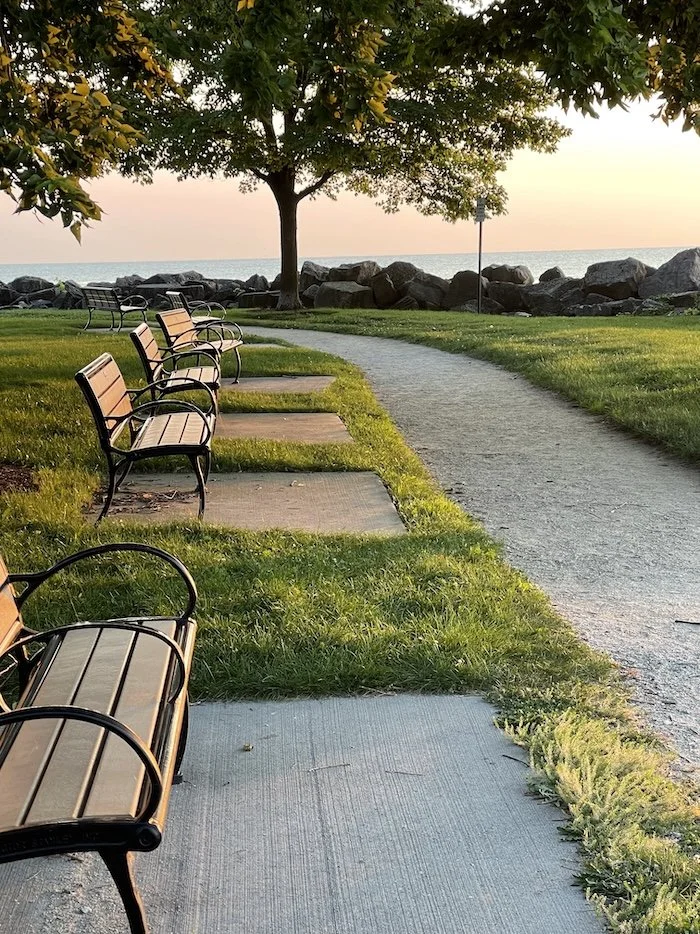
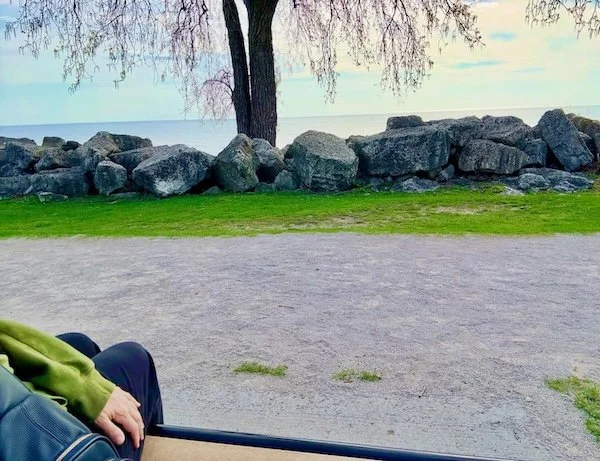
I realized I’ve been so busy that I haven’t been thinking about Rich as much as I normally do. On my walk, I did my usual stop-and-smell-the-flowers moment—lilacs are blooming this week. I sat on our favorite bench.
But instead of thinking about Rich, I did something different. I practiced embodied recall.
What did it feel like in my body to BE with him?
My body felt different than when I simply think about him. I felt calm, relaxed—safe. His presence could still be felt within me. How incredible is that?
It wasn’t narrative-based. It was sensation-based. My whole nervous system was involved.
Thinking-based memory can feel distant (and sometimes I worry those memories will fade). But this shifted from “Remember when we used to sit here?” to “I can still feel what it was like to be with you—and how you made me feel.”
This became a way to regulate myself. It didn’t last long—just a few minutes—but it was enough.
I want to practice this more—while eating at our favorite restaurant or watching our favorite show.
This is how grief can serve us.
We remember how they made us feel.
That kind of love is eternal—
even when memory begins to feel fragmented.
Kim Brandt is a writer, yoga therapist and Pilates instructor whose work explores grief, healing and human connection. After losing her husband to colorectal cancer in April of 2025, she began writing about caregiving, love, and life after loss. She lives in Illinois, where she is building a wellness community focused on resilience and repurposing life’s transitions.